Why Your Child Is Under the risk of Enamel Hypoplasia Even on a Healthy Diet for Kids
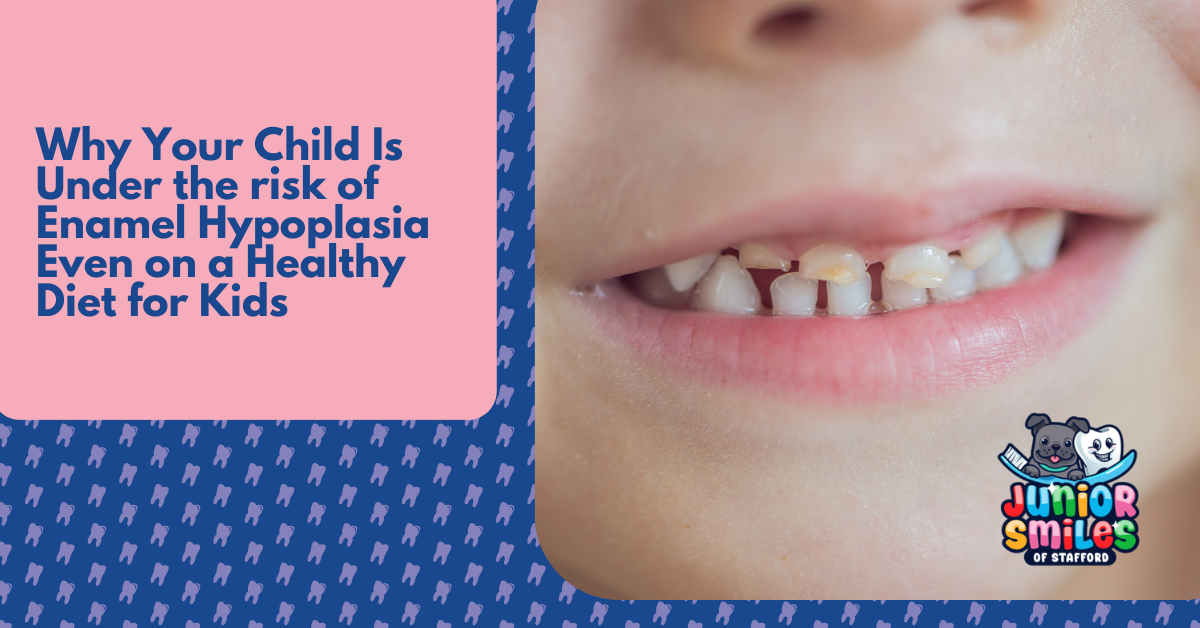
As pediatric dentists in Stafford, we see a common scenario that leaves health-conscious parents feeling frustrated and confused. You’ve done everything right: you’ve cut out candy, ditched the soda, and limited obvious sweets. Yet, when you look at your child’s teeth, you notice chalky white spots, yellowish tints, or even small pits and grooves, or what we call Enamel Hypoplasia
You’re not just seeing things. You may be looking at signs of enamel hypoplasia, a developmental condition where tooth enamel, the tooth’s protective outer layer, is thinner, weaker, or even missing. This makes the teeth more vulnerable to cavities, sensitivity, and damage.
If you’ve been asking yourself why your child has weak enamel despite your best efforts, the answer often surprises you. It might not be the obvious culprits you’ve already eliminated, but the hidden risks in your child’s “healthy” diet and, more importantly, how they consume it.
The Parent’s Dilemma: You’ve Ditched Candy, But the Dental Problems Persist. Why?
“We see parents in our Stafford office every week who are doing everything right, yet their child’s enamel is struggling,” our doctors at Junior Smiles of Stafford often share. “They bring in their child’s food log, and it’s full of organic fruit pouches, all-natural smoothies, and maybe even kombucha. The answer to their question, ‘Why are we still getting cavities?’ often lies in a concept that goes beyond just sugar content.”
The central mystery isn’t what your child is eating, but the frequency of their snacking and sipping habits. This brings us to a foundational concept in pediatric dentistry that every parent needs to understand.
The Real Culprit: It’s Not Just What They Eat, It’s How Often
Introducing the “Frequency of Exposure” Framework
According to the American Academy of Pediatric Dentistry (AAPD), the number of times a child’s teeth are exposed to acid is more damaging than the total quantity consumed in one sitting. This is called the “frequency of exposure” framework.
Here’s how it works:
- The Acid Attack: When your child eats or drinks something sugary or acidic, the bacteria in their mouth produce acid. This acid attack causes the pH level in their mouth to drop, and minerals begin to dissolve from their tooth enamel.
- The Recovery Period: It takes saliva 20 to 40 minutes to neutralize this acid and return the mouth to a safe pH, allowing the enamel to start remineralizing (rebuilding).
- The Constant Sipping Problem: If your child sips on a smoothie, juice, or sports drink over the course of an hour, they are re-starting the acid attack with every sip. Their mouth never gets the 20-40 minute break it needs to recover. This means their teeth are in a continuous state of demineralization, leading to weak enamel and decay.
A child who eats a small chocolate bar in five minutes and then drinks water exposes their teeth to one 20-minute acid attack. A child who sips on a “healthy” fruit smoothie for an hour exposes their teeth to a continuous 60-minute acid attack, causing significantly more damage.
The “Healthy” Hit List: Surprising Foods That Weaken Enamel
Many parents are surprised to learn that foods marketed as healthy can be highly acidic, weakening their child’s enamel. Acidity is measured by pH level; the lower the pH, the more acidic the substance. Pure water is neutral at 7.0, but enamel begins to demineralize at a “critical pH” of around 5.5.
Here’s how some common “healthy” snacks and drinks stack up:
While diet and eating habits are a major factor, they aren’t the only cause of weak enamel. Understanding the full picture is the first step toward protecting your child’s smile.
Understanding Enamel Hypoplasia: The Foundation of Your Child’s Dental Health
What Is Enamel Hypoplasia? A Simple Definition
Enamel hypoplasia is a defect that occurs while teeth are still developing under the gums. It’s not a cavity or a stain that happens after the tooth erupts; it’s a problem with the tooth’s fundamental structure. Think of enamel as a protective shield. In a child with hypoplasia, that shield was built with gaps, thin spots, or missing pieces, leaving the underlying tooth structure exposed and vulnerable. This condition is also known as underdeveloped teeth or, more broadly, dental hypoplasia.
How to Spot Enamel Hypoplasia: A Visual Guide for Parents
The signs of enamel hypoplasia can vary widely. If you’re examining your child’s teeth, be on the lookout for:
- Chalky white or opaque spots
- Yellowish or brownish stains
- Visible pits, grooves, or depressions on the tooth surface
- Teeth that seem to chip, wear down, or break easily
- Unusual sensitivity to hot, cold, or sweet foods
Is It Hypoplasia, Fluorosis, or Just a Stain?
Parents often confuse enamel hypoplasia with two other common conditions: dental fluorosis (caused by excessive fluoride intake during tooth development) and decalcification (the first stage of a cavity). Here’s a quick guide to tell them apart:
What Causes Enamel Hypoplasia? The Factors Beyond Diet
Because hypoplasia is a developmental issue, its causes are linked to events that can disrupt the body’s normal functions while teeth are forming. It’s important for parents to know that many of these factors are completely outside of their control, so there is no reason to feel guilty.
- H4: Prenatal Factors: A mother’s health during pregnancy is crucial. Maternal vitamin D deficiency, gestational diabetes, or certain infections can interfere with the proper formation of a baby’s primary teeth in utero.
- H4: Birth-Related Issues: Premature birth or low birth weight can interrupt the final stages of enamel mineralization, which primarily occurs in the third trimester. Physical trauma from intubation in the NICU can also cause localized defects in the front teeth.
- H4: Early Childhood Illnesses: High fevers from common childhood illnesses like pneumonia, measles, or even severe ear infections can temporarily halt the activity of enamel-forming cells. This can result in a visible line or band of flawed enamel on the teeth that were developing at the time of the fever.
- H4: Genetic Predisposition: In rare cases, enamel hypoplasia is caused by hereditary conditions like Amelogenesis Imperfecta.
Your Child Has Enamel Hypoplasia. What Now? A Treatment Plan for Stafford Families
If you suspect your child has enamel hypoplasia, the most important step is to get a professional diagnosis. Because these teeth are weaker, they are at a much higher risk for rapid decay and sensitivity. At Junior Smiles of Stafford, we build a personalized treatment plan to protect your child’s teeth and ensure their smile stays healthy and strong.
Step 1: Professional Assessment at Our Stafford Office
Every child is different, and there’s no one-size-fits-all solution for enamel hypoplasia. The journey begins with a comprehensive evaluation at our Stafford office. We’ll assess the severity of the hypoplasia, identify which teeth are affected, and discuss the best options for your child’s unique needs.
Let our specialists create a personalized plan to protect your child’s smile. Call us at (540) 699-2441 or schedule a consultation online today.
Step 2: In-Office Treatments to Strengthen and Protect
Based on our assessment, we may recommend one or more professional treatments designed to fortify and shield the vulnerable enamel.
Topical Fluoride Varnish
Why we use it: To fortify the existing enamel shield. Fluoride varnish is a highly concentrated treatment that we paint onto the teeth. It helps remineralize weak spots and makes the enamel more resistant to acid attacks. For some patients, we may also recommend non-invasive Silver Diamine Fluoride (SDF) to halt early decay.
Dental Sealants
Why we use it: To seal the deep grooves in molars from acid and bacteria. Dental sealants are thin, protective coatings applied to the chewing surfaces of back teeth. They act as a physical barrier, preventing food and plaque from getting trapped in the pits and grooves common in hypoplastic teeth.
Composite Resin Bonding
Why we use it: To cosmetically repair pits and add a protective layer. For teeth with minor pits or defects, we can use a tooth-colored composite resin material to fill in the gaps. This smooths the tooth surface, improves its appearance, and adds a layer of protection.
Pediatric Dental Crowns
Why we use it: The ultimate protection for severely compromised teeth. For teeth with significant enamel loss, a simple filling or bonding isn’t enough. A full-coverage pediatric crown (cap) covers the entire tooth, protecting it from decay and fracture. We use beautiful, natural-looking white zirconia crowns and durable stainless steel crowns to restore function and aesthetics.
Children with enamel hypoplasia may also have special healthcare needs or experience heightened dental anxiety, which is why our team is specially trained in gentle, sensory-friendly care and offers a full range of sedation options.
Step 3: A Proactive Home Care Strategy
Professional treatments are only part of the solution. An empowered home care plan reinforces the “frequency of exposure” framework and gives you the tools to protect your child’s teeth every day.
Rethink Your Drinks
Water and milk are best. Confine juices, fruit pouches, and smoothies to mealtimes only. Sipping on these drinks between meals creates the constant acid attacks that are so damaging to weak enamel.
Snack Smart
Choose tooth-friendly snacks like cheese, nuts, and crunchy vegetables (carrots, celery). These foods are low in sugar and can help stimulate saliva to neutralize acid. Avoid sticky, sugary, or acidic options like dried fruit, crackers, and granola bars that stick in the grooves of teeth.
Brush Better, Not Harder
Use a soft-bristled brush and a fluoride toothpaste. Based on ADA and AAPD guidelines, children from birth to age 3 should use a “smear” (the size of a grain of rice), and children 3 to 6 should use a “pea-sized” amount. We can recommend the best one for your child’s age and needs during your visit.
The Power of Rinsing
A simple rinse with water after any snack or acidic drink is incredibly effective. It helps wash away residual sugars and neutralize acids, giving the saliva a head start on the recovery process.
Your Partner in a Lifetime of Healthy Smiles – Junior Smiles of Stafford
Seeing signs of weak enamel on your child’s teeth can be worrying, but you are not alone, and there are effective solutions. At Junior Smiles of Stafford, we believe in empowering parents with knowledge and partnering with you to create a proactive plan for your child’s dental health. Our philosophy is built on prevention, education, and creating a kid-friendly environment where every child, especially those with anxiety or special needs, can feel safe and confident.
If you have concerns about your child’s enamel or are a military family looking for a trusted pediatric dentist in Stafford, VA, we’re here to help.
Schedule a consultation today at (540) 699-2441 or request an appointment Request an Appointment