If you have ever stood in the toothpaste aisle of a Stafford grocery store, staring at forty different tubes of “kids’ formula” while feeling completely paralyzed, you are not alone. One box says “0-2 years,” the next says “stages 1, 2, and 3,” and another claims to be “natural” but doesn’t mention fluoride.
As a pediatric dentist, I see this frustration every week. Parents want to do the right thing, but “brush twice a day” is generic advice that doesn’t account for the massive developmental leaps a child takes between their first birthday and their twelfth. What works for a toddler can be ineffective for a second-grader, and what a pre-teen needs is often overlooked entirely.
This home oral care guide is designed to end the guesswork. This isn’t just a list of tips; it is the exact protocol we use and recommend at Junior Smiles of Stafford, broken down by the six distinct developmental milestones your child will hit.
Why ‘Brush Twice a Day’ Isn’t Enough Advice
Following a one-size-fits-all approach to oral hygiene usually leads to two problems: using the wrong products for the current stage of enamel development or handing over independence before a child has the motor skills to handle it.
Oral care needs to evolve alongside your child’s hand-eye coordination. A common rule of thumb we use in pediatric dentistry is that if a child cannot yet tie their own shoelaces or write in clear cursive, they likely do not have the fine motor skills required to brush all surfaces of their teeth effectively.
To ensure your child’s smile stays healthy, we need to match the tool and the technique to their specific age.
Stage 1: Birth to First Tooth (Months 0 to About 6)
What to Use Before There Are Teeth
Even before that first pearly white erupts, oral hygiene is necessary. While there is no enamel to decay yet, bacteria can still colonize the gum tissue. Citing the American Academy of Pediatric Dentistry (AAPD), we recommend beginning oral hygiene at birth.
The Tools:
- A damp, clean washcloth: Simple and effective for wiping gums after feedings.
- Silicone finger brush: Look for medical-grade, BPA-free silicone. These are excellent for clearing away oral biofilm (the thin layer of bacteria that forms in the mouth) and massaging the gums.
Why Starting Now Makes Age 2 Easier
Parents often ask why they should bother cleaning a toothless mouth. The answer is behavioral. Children who become accustomed to having their mouths cleaned as infants are significantly more cooperative when the “real” brushing begins as toddlers. Think of this stage as an investment in future cooperation. It establishes a “dental home” routine long before their first dental visit.
Stage 2: First Tooth Through Age 3 (The Rice-Grain Stage)
The moment that first tooth breaks through the gum line, the rules change. You are now protecting enamel, which is thinner and more fragile in primary (baby) teeth than in permanent teeth.
Toothbrush Selection and the Rice-Grain Rule
For this stage, you need an infant toothbrush.
- The Brush: Look for a small head (approximately 15mm to 20mm) and an age-appropriate handle that fits your hand, as you will be doing 100% of the work.
- The Bristles: Ensure they are “soft-bristled.” In clinical terms, look for bristles with “rounded ends.” Tapered ends can sometimes be too sharp for delicate toddler gum margins.
- The Amount: Use a “smear” or a “rice-grain” amount of fluoride toothpaste. This is approximately 0.1mg of fluoride a safe amount even if the child hasn’t learned to spit yet.
The Fluoride Question, Answered Directly
I understand there is conflicting information online regarding fluoride. However, enamel mineralization is most active during these early years. A rice-grain application is topical and well below the “Tolerable Upper Intake Level” that would cause mild fluorosis or toxicity. At Junior Smiles, we view fluoride as a way to remineralize early enamel lesions before they become cavities. If you have specific concerns, we always welcome an open, evidence-based discussion during professional fluoride treatments at our office.
Introducing Floss (Around Age 2 to 3)
The moment two teeth start touching, a toothbrush can no longer reach the surfaces between them. This is when you introduce flossing.
- What to use: Youth floss picks. Look for a small handle grip and “tape” style floss, which is flatter and easier to slide between tight toddler teeth than traditional round string.
- The routine: This is a parent-led, once-daily task. It takes five seconds but prevents “interproximal” (between-the-teeth) cavities that are difficult to see without X-rays.
For children who are particularly uncooperative at this stage, some parents find that sedation dentistry for children, such as mild nitrous oxide, helps provide a positive, fear-free experience during clinical exams.
Stage 3: Ages 3 to 6 (The Pea-Sized Amount Era)
At age three, most children have their full set of 20 primary teeth, and their manual dexterity is improving.
The Upgrade to Pea-Sized Toothpaste
You can now transition to a “pea-sized” amount of fluoride toothpaste (approx. 0.25mg).
- Visual Guide: A pea-sized amount should cover the width of the bristles but not be piled high on top.
- The Brush: Move to a toddler toothbrush with a slightly larger head and a longer handle that the child can begin to grip.

The ‘Parent Goes Second’ Rule for Supervision
This is the most critical stage for behavioral training. We use the “Parent Goes Second” rule:
- Child Brushes First: This builds their technique awareness and sense of autonomy.
- Parent Brushes Second: You go back in and “buff” the surfaces they missed usually the molar surfaces and the gum line.
This rule should continue until the child can reliably demonstrate full coverage, which usually happens between ages 6 and 8.

Stage 4: Ages 6 to 9 (First Permanent Molars and the Sealant Window)
Why Age 6 Is the Most Important Dental Year
Around age six, the “first permanent molars” arrive. These teeth do not replace baby teeth; they erupt behind the last primary molars. Many parents miss their arrival entirely. These are the teeth your child will keep for the next 70+ years, yet they have deep pits and “fissures” that are disproportionately prone to decay because a 6-year-old’s brushing technique isn’t yet perfect.
Dental Sealants: Your Secret Weapon
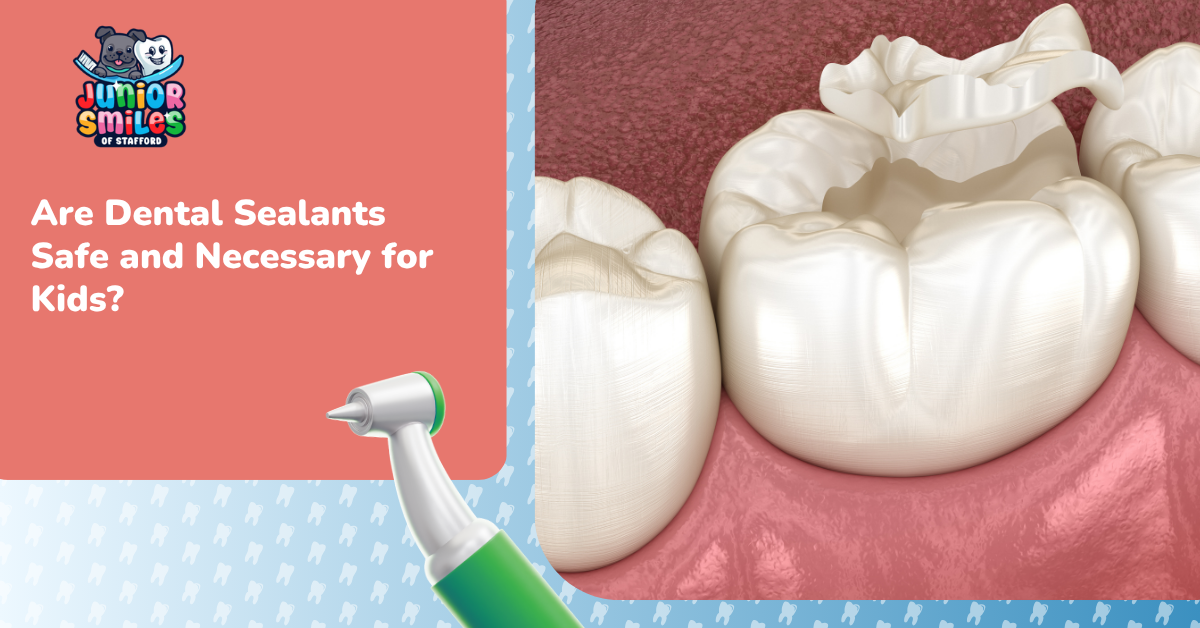
Because of those deep fissures, we highly recommend Dental Sealants. A sealant is a thin, protective plastic coating applied to the chewing surfaces of the back molars.
- The Benefit: According to the ADA, sealants prevent up to 80% of cavities in back teeth.
- The Window: The best time to apply them is immediately after eruption, before any decay can start.
At Junior Smiles, we check the eruption status of these molars at every visit. If we do find early signs of decay during this transition, we offer restorative dentistry like tooth-colored fillings to preserve the tooth structure.
Flossing Independence
Ages 6 to 8 is when children begin to develop the fine motor coordination to use floss picks solo. However, keep up the “spot check.” If you see visible plaque along the gum line, it means they need another year of “Parent Goes Second.”
Stage 5: Ages 9 to 12 (Building Real Independence)
When to Hand Over the Brush Completely
There is no fixed age for “retirement” from supervision. Instead, I recommend an at-home assessment:
- Have your child brush unsupervised for one week.
- At the end of the week, perform a “Flashlight Inspection.”
- Check the “First-molar blind spot” the cheek-side surface of the very back teeth.
- If those surfaces are clean for two consecutive weeks, they have earned independence.
You can also use “disclosing tablets” (chewable tablets that dye plaque purple) to help your child see exactly where they are missing. Bring the results to their semi-annual cleanings, and we can do a professional plaque check together.
The Age-by-Age Quick Reference: What to Buy
These are the same recommendations we use for our own children. While these milestones are the standard, every child develops on a slightly different timeline, especially our patients with special sensory needs.
Home routines are the foundation of oral health, but they are most effective when paired with comprehensive dental exams. During your child’s next visit, we can walk through their specific brushing technique with you and personalize this guide to their current developmental stage.
If you are looking for the best pediatric dentist in Stafford, Junior Smiles of Stafford team is here to help your child transition through every stage with confidence.
Not sure which stage your child is in or if their technique is actually working? Book a visit at Junior Smiles of Stafford or call 540-699-2441. We’ll walk through their brushing routine with you and make sure they’re set up for every stage ahead.