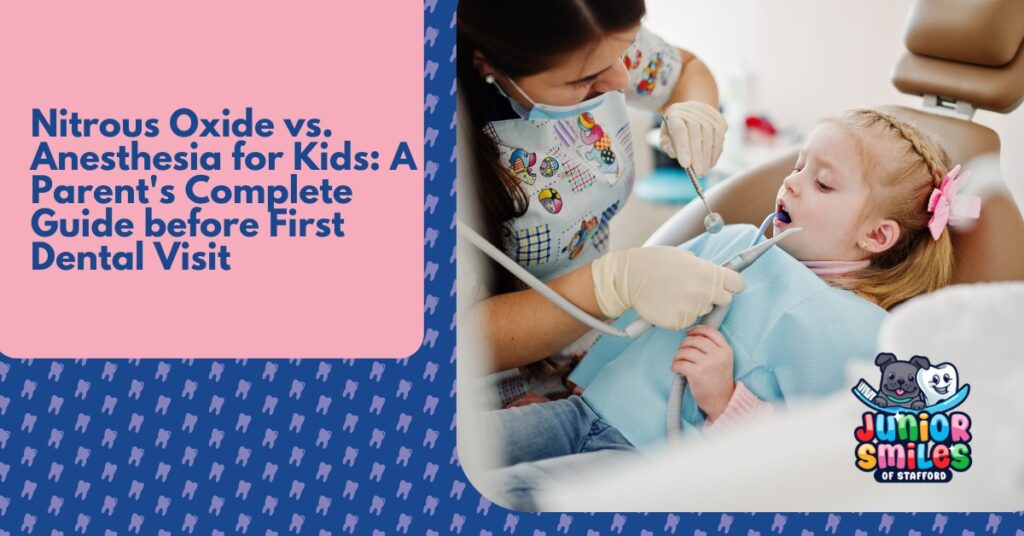
The moment a dentist suggests your child might need sedation is often overwhelming. As a parent, your mind races with questions: Is it safe? Is it necessary? What does it mean? You want to make the best decision for your child, but the path forward seems unclear and stressful.
At Junior Smiles of Stafford, we understand. We believe every parent deserves peace of mind and every child deserves gentle, anxiety-free dental care during their first dental visit. This guide is the first step.
We are here to replace your anxiety with clarity by walking you through nitrous oxide vs anesthesia and every option available at our pediatric dental office in Stafford, Virginia. This is your guide to choosing the right path for your child’s comfort and safety.

Why Might My Child Need Sedation Dentistry?
Sedation is not a last resort. It is a safe and effective tool that helps us provide positive and successful dental experiences. Many children who were once terrified of the dentist now complete their treatment comfortably and leave with a smile.
Your child might benefit from sedation if they have:
- Significant dental anxiety or phobia: An overwhelming fear that prevents them from cooperating.
- A young age: Toddlers and young children often cannot remain still long enough to perform precise dental work safely.
- The need for complex or extensive treatment: Sedation allows us to complete multiple dental procedures in a single, stress-free visit.
- Special healthcare needs: For children with conditions like Autism Spectrum Disorder (ASD) or Sensory Processing Disorder (SPD), sedation helps mitigate sensory overload and makes essential dental care possible.
- A strong gag reflex: An involuntary gag reflex makes it physically impossible for a dentist to work safely.
Understanding the Sedation Pathway: A Spectrum of Comfort for Your Child
Sedation is not one procedure. It is a spectrum of options. Each option provides a specific level of support for your child’s needs.
- Stop 1: Light Relaxation (Nitrous Oxide)
- Stop 2: Calm & Drowsy (Oral Conscious Sedation)
- Stops 3 & 4: Light to Deep Sleep (IV Sedation & General Anesthesia)
Stop 1 on the Pathway: Light Relaxation with Nitrous Oxide (Laughing Gas)
Nitrous oxide, often called “laughing gas,” is the most common and gentlest first step for managing mild dental anxiety. It is recognized by the American Academy of Pediatric Dentistry (AAPD) as a safe and effective method for creating a relaxed and positive experience. Despite its name, it does not make all children laugh. It helps them feel calm and happy.
Who is a Good Candidate for Nitrous Oxide?
This is an ideal option for children with mild anxiety, a strong gag reflex, or those who need a little help relaxing during simple procedures like a filling or cleaning.
What Does It Feel Like for Your Child?
Your child will breathe the gas through a small, comfortable nose mask. To make the experience fun, we use flavored masks in scents like strawberry or bubblegum, which gives your child a sense of control. Within 3-5 minutes, they will feel calm and relaxed. Many children describe feeling warm, tingly, or a sensation of “floating.” They remain fully awake and able to talk with us throughout the entire visit.
The Safety & Recovery Process
Nitrous oxide has a rapid onset because it has low solubility in the blood, meaning it works quickly and is eliminated just as fast. Once the procedure is finished, we switch the mask to 100% oxygen for about five minutes. This flushes the nitrous oxide from their system. This prevents a rare side effect called diffusion hypoxia and ensures your child feels completely normal before they leave the chair. They can return to school or their regular activities immediately.
Stop 2 on the Pathway: Calm & Drowsy with Oral Conscious Sedation
For children with more significant anxiety or those who need longer procedures, oral conscious sedation offers a deeper level of relaxation. This involves your child drinking a small amount of liquid medication in our office before their appointment.
Commonly used medications include benzodiazepines like Midazolam (Versed) or Diazepam (Valium), which provide excellent anxiety relief. Dosages are not one-size-fits-all. They are carefully calculated based on your child’s weight, age, and medical history to ensure safety.
Who is a Good Candidate for Oral Sedation?
This level is best for toddlers and young children who are too young to cooperate, children with moderate dental anxiety, or those needing longer appointments that would be difficult to sit through otherwise.
Preparing for Your Visit: Fasting & Transportation
For your child’s safety, strict fasting is required to reduce the risk of aspiration. Your child’s stomach must be empty before receiving oral sedation.
- 8 hours before: No fried, fatty, or solid foods.
- 6 hours before: No infant formula, non-human milk, or light meal (like toast).
- 4 hours before: No breast milk.
- 2 hours before: No clear liquids (like water or apple juice without pulp).
After the appointment, your child will be groggy and uncoordinated. Two adults must be present for the drive home: one to drive and one to sit in the back and monitor the child.
What to Expect After the Appointment
During the procedure, we use advanced monitoring equipment, including a pulse oximeter to track heart rate and oxygen levels. After treatment, your child will need to recover at home under direct adult supervision for the rest of the day. Let them rest, start with clear liquids, and slowly transition to soft foods. No school, sports, or active play for 24 hours.

Stop 3 & 4 on the Pathway: Light to Deep Sleep with IV Sedation & General Anesthesia
For children with profound anxiety, extensive dental needs, or certain medical conditions, deeper levels of sedation ensure treatment is completed safely and without causing psychological trauma. These options allow a child to be completely asleep, unaware of the procedure.
While the terms are often used together, there is a key difference:
- IV Sedation (Deep Sedation) is often administered in-office by a specialist.
- General Anesthesia (GA) induces a deeper state of unconsciousness and is sometimes performed in a hospital or ambulatory surgical center for the most complex cases.
Who Needs IV Sedation or General Anesthesia?
This path is reserved for specific situations, such as:
- Children with severe dental phobia who cannot be treated otherwise.
- Very young children who require extensive restorative work.
- Children with certain medical or special healthcare needs that prevent cooperation.
- Patients needing a large volume of dental work find it safer and less traumatic to complete in one visit while asleep.
The Team Approach: Our Commitment to Safety
Patient safety is our absolute priority. When your child is under deep sedation or general anesthesia, we adhere to the strictest safety protocols from the American Academy of Pediatrics, equivalent to a hospital operating room.
- The Dual-Provider Model: The procedure involves at least two specialist doctors: our pediatric dentist performing the treatment and a board-certified Dental Anesthesiologist whose sole job is to administer the medication and monitor your child’s vitals from start to finish.
- Hospital-Grade Monitoring: We use a full suite of monitoring equipment, including pulse oximetry (oxygen levels), EKG (heart rhythm), blood pressure monitoring, and capnography (end-tidal CO2). Capnography is the gold standard because it monitors ventilation in real-time, giving the earliest indication of any breathing change.
- Emergency Preparedness: Our clinical team is certified in Pediatric Advanced Life Support (PALS), and we maintain a fully stocked emergency cart with age-appropriate equipment and reversal agents.
Recovery: Helping Your Child Wake Up Comfortably
After the procedure, the anesthesiologist will oversee your child’s recovery in a quiet, supervised area. They will remain with you until your child is stable, comfortable, and meets strict criteria for discharge. Home care instructions are similar to oral sedation, requiring close supervision for the rest of the day.
The Sedation Pathway: A Quick Comparison
A Special Note for Parents of Children with Special Needs
For a child with Autism Spectrum Disorder (ASD) or a Sensory Processing Disorder (SPD), the sights, sounds, and smells of a dental office are often overwhelming. Sedation manages fear. It is also a clinical tool that prevents the neurological “redline” of sensory overload. This makes essential care possible and trauma-free.
It provides anxiolysis and amnesia, ensuring your child has no memory of the distressing parts of the visit. This breaks the cycle of medical trauma and preserves their willingness to seek healthcare in the future. At Junior Smiles of Stafford, we have extensive experience creating a positive, sensory-friendly environment for neurodivergent children. We understand the risk of paradoxical reactions to certain medications and rely on both objective physiological monitoring and close partnership with you to ensure a safe and successful visit.
Your Role as a Parent: How to Prepare for a Smooth & Safe Visit
You are the most important member of your child’s care team. Your preparation and calm confidence make a world of difference.
Talking to Your Child
Use simple, positive, and age-appropriate language. Avoid “scary” words.
- For Toddlers (2–5): “The doctor will use some ‘magic sleepy air’ to help you take a special nap while they make your teeth sparkly. I’ll be right here when you wake up!”
- For School-Age Kids (6–11): “A special doctor is going to help you get into a ‘medical sleep’ so you won’t feel, hear, or see anything. They watch over you the whole time, and when the dentist is done, they’ll gently wake you up.”
- For Adolescents (12+): “You’ll be getting anesthesia, which is a medicine that keeps you completely comfortable and asleep. You won’t remember the procedure. The anesthesiologist is a specialist who will monitor you the entire time.”
Following Pre-Visit Instructions
Strictly follow all fasting (NPO) guidelines. An empty stomach is the most critical safety rule for sedation. Dress your child in loose, comfortable two-piece clothing, and remove any nail polish so our oxygen sensors work properly.
What to Bring
Bring a comfort item like a favorite blanket, stuffed animal, or pacifier. This “transition object” provides a sense of security in an unfamiliar environment.
Post-Visit Care
Plan for a quiet, restful day at home after any oral or IV sedation. Your child will need your full attention. Arrange for another adult to be present if possible, and plan a soft-food menu of their favorite things, like yogurt, Jell-O, or applesauce.
Have Questions? Let’s Find the Right Path for Your Child Together
It is normal to feel uncertain. This is a significant decision for any parent. The best choice is a personal one made with a pediatric dental expert who answers all your questions and helps you weigh the options for your child’s unique needs.
At Junior Smiles of Stafford, we are here to be your partner. Let’s start the conversation.
 Call us today at (540) 699-2441 or request an appointment online to schedule a consultation. We are located at 963 Garrisonville Rd #103, Stafford, VA 22556, and we look forward to helping your child achieve a healthy, happy smile.