You’re standing in a brightly colored lobby in Stafford or Northern Virginia, your child’s hand in yours, when the receptionist gives you the standard instruction: “You’ll need to wait here in the lobby while we take your child back for their treatment.”
For many parents, this moment triggers an immediate sense of dissonance. Your protective instinct says you should be there, especially if your child is nervous. However, the professional policy says otherwise. Often, when parents ask “Why?”, they receive a dismissive “It’s just our policy” or a vague “It’s better for the child.”
At Junior Smiles of Stafford, we believe that high-trust relationships are built on transparency, not just “policies.” If you are a research-oriented parent, you want to understand the clinical reason and the evidence behind these decisions. This guide explores the “Pediatric Dental Triad,” the mixed scientific research on parental presence, and how specialized practices are reframing the conversation from presence to partnership.

Why Practices Have This Policy (and Why the Reasoning Varies)
The decision to ask parents to wait in the lobby isn’t about excluding you; it is based on three primary clinical pillars: the “spatial choreography” of the room, the transfer of anxiety, and the direct relationship between the dentist and the patient.
1. The Spatial Choreography of Safety
A standard dental operation is a high-precision environment. Most specialized pediatric dental care teams utilize “4-handed” or “6-handed” dentistry. This means the dentist and one or two assistants are moving in a synchronized “arc of movement” around the child’s head.
In a small treatment room, a physical parental presence can inadvertently disrupt this arc. High-speed instrumentation requires absolute stability; a parent reaching out to hold a hand or accidentally bumping an assistant’s elbow during a precision composite bond can pose a legitimate safety risk.
2. The Pediatric Dental Triad and Anxiety Transfer
Clinical guidelines from the American Academy of Pediatric Dentistry (AAPD) refer to the “Pediatric Dental Triad” the relationship between the Dentist, the Patient, and the Parent. Research suggests that “anxiety transfer” is a real phenomenon. If a parent is subtly anxious (even if they are trying to hide it), the child often mirrors that stress marker.
3. Direct Rapport Building
Pediatric dentists are trained to use non-pharmacological behavior guidance. When a parent is present and constantly translating or repeating the dentist’s instructions, the child may look to the parent for cues rather than focusing on the dentist. By establishing a direct line of communication, the dentist can more effectively use techniques like “Tell-Show-Do” to build the child’s independent coping skills.
What the Research Actually Says
If you’ve looked for a clear answer in the scientific literature, you likely found that the evidence is surprisingly mixed. This is why “no-parent” policies remain a point of clinical judgment rather than a settled mandate.
- Studies Supporting Absence: Historically, many studies utilizing the Frankl Behavior Rating Scale (a standard tool for measuring child cooperation) showed that children ages 4 and older often demonstrated improved behavior when parents were in the lobby. The logic was that children “performed” more for their parents or engaged in more “attention-seeking” resistance.
- Studies Supporting Presence: More recent systematic reviews, including those from the Cochrane Database of Systematic Reviews (post-2015), have found no significant difference in cooperation levels for many children. In fact, some data suggests that for certain children, having a parent present can actually reduce heart rates and other physiological stress markers.
- The “Clinical Pivot Point”: Research identifies age 3 or 4 as the typical developmental “pivot point.” Before this age, “knee-to-knee” exams (where the child sits on the parent’s lap) are standard because independent coping hasn’t emerged. After age 4, many children are developmentally ready to build an independent relationship with their healthcare providers.
Ultimately, the research tells us that there is no one-size-fits-all answer. A child’s temperament, their previous dental history, and the complexity of the procedure all play a role in the “calculus of care.”

How the Answer Changes by Treatment Type
The necessity for parental exclusion often shifts depending on what is actually being done chairside. Not all appointments carry the same clinical requirements.
Preventive visits (exams, cleanings, digital X-rays)
Parental presence is most commonly accepted and even encouraged during routine cleanings and exams. These visits are low-stakes and focused on education. For first-timers, these visits serve as an “orientation” where parents can see how the staff interacts with their child. We often find that negotiating presence at this stage builds the trust needed for more complex work later.
Restorative treatment (white fillings, crowns, baby root canals)
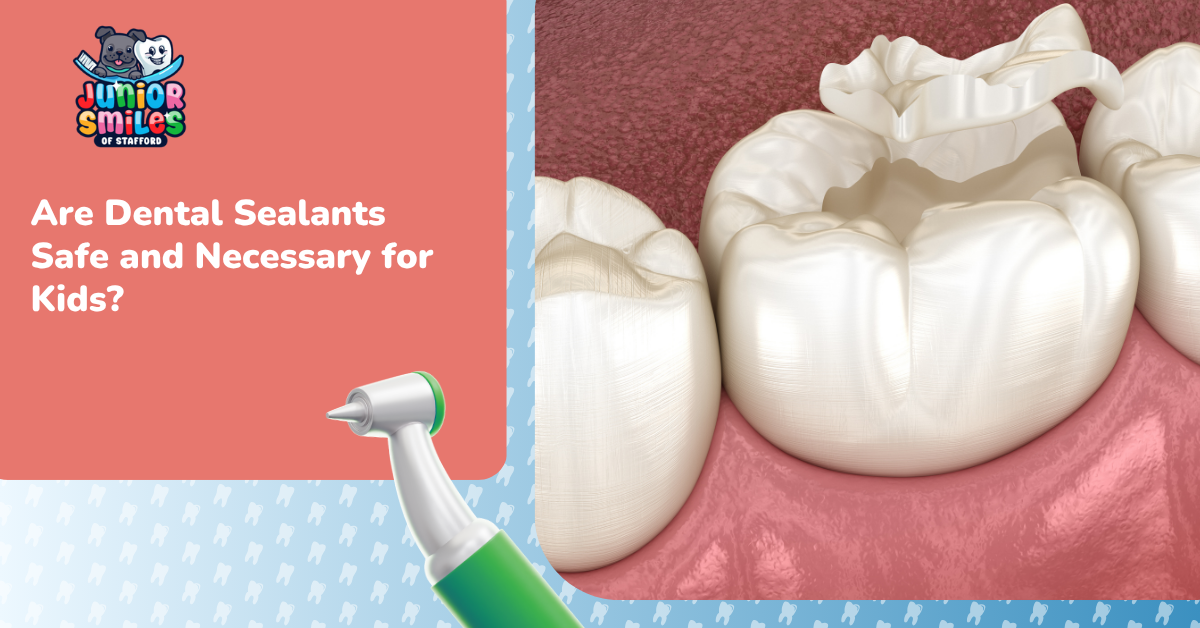
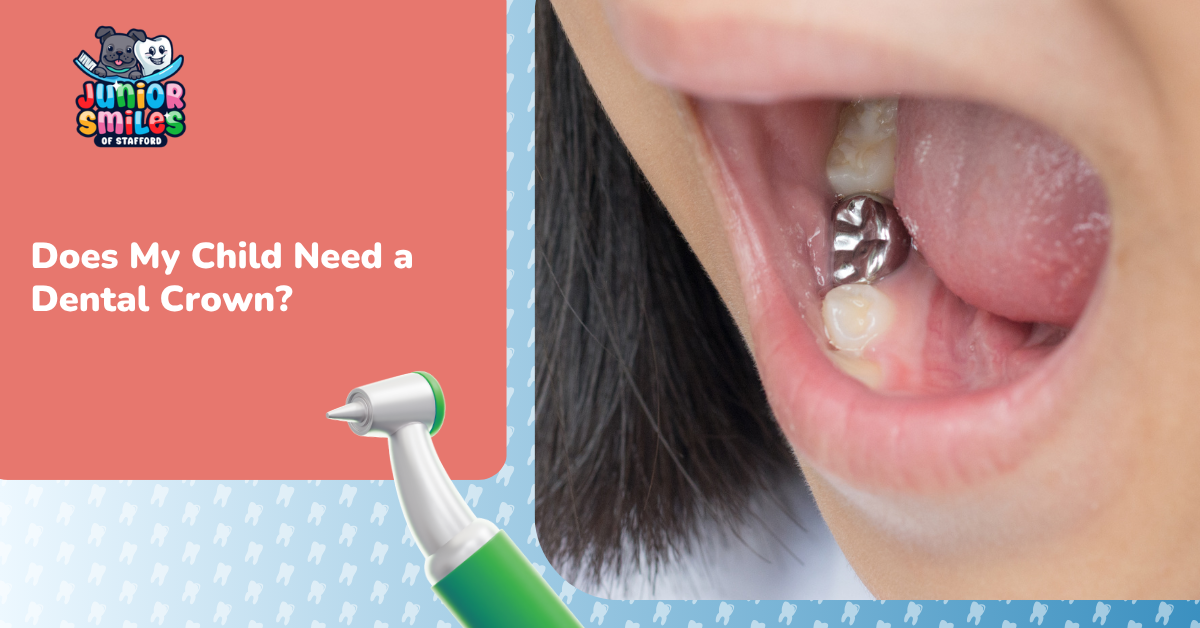
This is where policies often tighten. Restorative dental treatments like fillings, crowns, or pulpotomies (the treatment of infected pulp in a baby tooth, often called a “baby root canal”) require moisture control and high-speed instrumentation.
A single sudden movement or “startle reflex” can compromise a composite bond or lead to a soft-tissue injury. In these high-precision scenarios, many dentists prefer a contained environment where the child is focused solely on the dental team’s instructions.
Sedation appointments (nitrous oxide and general anesthesia)
Pharmacological behavior management changes the behavioral calculus entirely.
- [Nitrous oxide (laughing gas)](https://juniorsmilesofstafford.com/): This safe, mild sedative keeps the child conscious but relaxed. It often alters their perception of sound and time, making the procedure feel like a brief, distant event. Because the child is in a relaxed state, the need for external parental soothing is clinically reduced.
- General Anesthesia: In complex cases or for children with severe special needs, general anesthesia may be used. AAPD protocols typically allow parents to be present during “Induction” (going to sleep) and “Recovery” (waking up), but the procedure itself is a “closed” surgical environment for safety and sterility.
- The SDF Alternative: For parents who are strictly against separation or sedation, Silver Diamine Fluoride (SDF) is a non-invasive liquid that can stop cavity progression without drilling. Because it eliminates the “drill and fill” anxiety, it often allows for restorative care with the parent present.
Questions to Ask a Practice Before You Say Yes
You should never feel that questioning a policy is a confrontation. A “Parent-Partnering” practice should be able to answer these five questions with clarity and respect:
- Is your presence policy “blanket” or “procedure-specific”? (Does it change between a cleaning and a filling?)
- How do you handle “separation anxiety” for first-time patients?
- What is the protocol if my child becomes uncooperative mid-procedure? (Will I be called back, or will the procedure be paused?)
- How are the findings and the treatment plan communicated if I am not in the room?
- What specific behavior management training does your staff undergo?
What Good Behavior Management Actually Looks Like
When a dentist asks you to wait in the lobby, they aren’t relying on “force”; they are relying on a specialized toolkit of behavior guidance techniques.
- Tell-Show-Do: The dentist Tells the child what will happen in simple terms, Shows them the tool (e.g., “This is the tooth-tickler, feel it on your fingernail”), and then Does the procedure.
- Labeled Praise: Instead of saying “good job,” staff use specific praise: “I love how still you are keeping your hands.”
- Voice Control: This is the clinical use of a controlled, firm, yet kind tone to gain a child’s attention. It is a tool for safety, though sometimes misunderstood by parents as “yelling.”
- Guided Distraction: The use of ceiling-mounted screens or storytelling to redirect the child’s focus away from the sensory input of the dental work.
The Bottom Line for Parents Who Want to Stay Involved
Being an involved parent in your child’s dental care is not synonymous with being physically present in the operatory during every second of a procedure. True involvement looks like:
- Reviewing the treatment plan together before work begins.
- Involving the parent in decisions regarding sedation or minimally invasive options like SDF.
- A thorough post-appointment “debrief” where findings are shared via digital images or intraoral cameras.
The right pediatric dental home views you as a partner in care from the first pediatric dental visit forward. If a practice treats your desire for transparency as a problem to be managed rather than an instinct to be respected, they may not be the right fit for your family.
explore what to expect at Junior Smiles of Stafford and see how we create a calm, child-friendly environment where parents are always treated as informed partners.