If you’ve recently found yourself leaning close to your child with a phone flashlight, staring at a small spot on a back molar and wondering if your eyes are playing tricks on you, you aren’t alone. That “I noticed something” and “Is that spot on my child’s teeth a cavity?” moment is one of the most common reasons parents visit us here in Stafford.
As a parent, your instinct is your best tool. You aren’t looking for vague reassurances; you’re looking for accuracy. At Junior Smiles of Stafford, we want to help you decode what you are seeing. Understanding how a cavity moves through a baby tooth and how it differs from a permanent tooth is the first step in making a confident decision for your child’s health.
Why Cavities Happen in Young Children (Beyond the Obvious)
It is a common misconception that cavities are solely the result of too many sweets. While diet plays a role, the biological process is more complex.
The Bacteria Behind Early Childhood Decay
The primary culprit is a bacterium called Streptococcus mutans. These bacteria feed on fermentable carbohydrates (sugars and starches) and convert them into lactic acid. This acid then begins the process of “demineralization,” where it dissolves the essential minerals that keep teeth hard.
Interestingly, children aren’t born with this bacteria. It is often introduced through “vertical transmission” a clinical term for the passing of bacteria from caregiver to child. This can happen through shared utensils, blowing on a child’s food to cool it down, or even kissing. For health-conscious parents, understanding that oral health is a “sharable” condition within a family is often a major “I didn’t know that” moment.
Why Young Enamel is More Vulnerable
Baby teeth are not just smaller versions of adult teeth; they are built differently. The enamel layer on a primary (baby) tooth is significantly thinner than on a permanent tooth. Because there is less “armor” to protect the sensitive inner layers, decay can move through a baby tooth much faster than it would in an adult. This is why we prioritize Comprehensive Dental Exams to monitor enamel density and strength before a small spot becomes a larger issue.
The Cavity Progression Timeline: What is Happening Before You See It
A cavity doesn’t appear overnight. It follows a structured four-stage timeline. Identifying a problem in the earliest stages can mean the difference between a simple, non-invasive fix and a more complex restorative procedure.
Stage 1: Demineralization (The White Spot Stage)
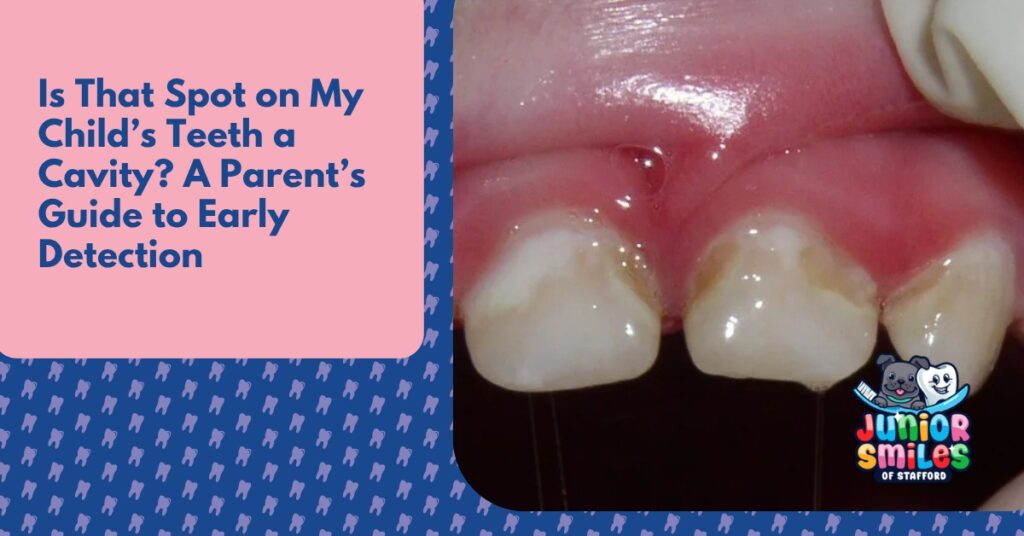
This is the only reversible stage of decay. It appears as a small, chalky white spot on the tooth’s surface. At this point, the enamel has lost minerals but hasn’t actually broken yet. If caught now, we can often “re-harden” the area using high concentrations of fluoride or minerals like calcium and phosphate.
Image source: https://www.mchoralhealth.org/flvarnish/mod3_2_3.html
Stage 2: Enamel Erosion (Chalky Opacity)
As the acid continues its work, the white spot may begin to look more “matte” or opaque. If you were to touch it with a dental tool, it might feel slightly rough or “sticky” compared to the smooth, glossy surface of healthy enamel. This indicates the structure is beginning to fail.
Image source: https://drmala.com.au/diagnosis/chalky-teeth-enamel-defects/
Stage 3: Dentin Decay (Brown Discoloration)
Once the decay breaks through the enamel, it reaches the dentin—the softer layer underneath. Dentin decays much faster than enamel. Visually, this looks like a light brown or tan spot. At this stage, your child might begin to feel occasional sensitivity to cold liquids or sweets.

Image source: https://bloorkidsdental.com/discoloration-of-childrens-teeth/
Stage 4: Cavitation (The Visible Pit or Hole)
This is what most people recognize as a “cavity.” The structure has collapsed, leaving a visible hole or dark pit. Because baby teeth have larger pulp chambers (where the nerves are located) relative to their size, decay at this stage can quickly lead to “pulpitis” or nerve inflammation.

How to Check Your Child’s Teeth Right Now?
You can perform a preliminary check at home using your phone’s flashlight. Focus your attention on the “fissures” or deep grooves of the back molars, as these are the highest-risk areas due to their depth.
The Parent’s Visual & Behavioral Checklist:
Visual “Yellow Flags” (Worth a closer look):
- White Spots: Chalky, dull spots near the gumline or in the grooves.
- Texture Changes: Areas that look “pitted” or less shiny than the rest of the tooth.
- Location: Any discoloration in the back molars (the first and second primary molars).
Visual “Red Flags” (Professional assessment warranted soon):
- Brown/Black Spots: Any dark discoloration that doesn’t brush away.
- Visible Holes: A shadow or pit that appears to hold food particles.
- Swollen Gums: Redness or a small “pimple” on the gums near a specific tooth.
Behavioral Indicators:
- Fussy Eating: Avoiding hard or crunchy foods they usually love.
- Chewing Preference: Only using one side of the mouth to chew.
- Non-Verbal Cues: Pulling at the ears or rubbing the jaw (often confused with ear infections in toddlers).
- Sensitivity: Reacting to very cold water or sugary snacks.
If you identify any of these signs, it is time to schedule a professional assessment to determine the best path forward.
Why a Cavity in a Baby Tooth is Not a ‘Wait and See’ Situation
We often hear the phrase, “They’re just going to fall out anyway.” While true, the health of a baby tooth directly dictates the health of the permanent tooth waiting underneath.
The Impact on Permanent Teeth
The developing permanent tooth bud is located directly beneath the roots of the baby tooth. If a baby tooth becomes infected or abscessed, it can physically scar the permanent tooth before it even emerges. This is a condition known as “Turner’s Hypoplasia,” which can lead to permanent discoloration or weakened enamel on the adult tooth.
Space Maintenance and Jaw Development
Baby teeth act as “space savers” for the adult teeth. If a primary molar is lost too early due to a cavity, the neighboring teeth can begin to tilt and shift a process called “mesial drift.” This can block the permanent tooth from coming in straight, leading to the need for complex and expensive orthodontics later in life. In these cases, we often have to use Space Maintainers to hold that spot open.
Quality of Life
According to the CDC, dental pain accounts for over 51 million lost school hours annually in the US. A child in dental pain eats less, sleeps worse, and has a harder time focusing in the classroom. Proactive treatment, such as Silver Diamine Fluoride (SDF), can often stop decay in its tracks without the need for traditional “drilling” if caught early enough.
What Careful Parents Often Overlook
Even the most diligent parents can miss a few counterintuitive facts about pediatric oral health:
- The pH-Timing Issue (The Stephan Curve): Clinical research shows that the frequency of snacking is more damaging than the amount of sugar consumed. Every time your child eats, their mouth becomes acidic for about 20 minutes. Four small crackers eaten over an hour (four separate “acid attacks”) is harder on the enamel than a cookie eaten in five minutes.
- The No-Rinse Rule: After brushing with fluoride toothpaste, have your child spit but not rinse with water. This maintains a “fluoride reservoir” on the teeth, allowing the minerals more time to strengthen the enamel.
- The “Age One” Standard: The American Academy of Pediatric Dentistry (AAPD) recommends the first visit by age one, or within six months of the first tooth appearing. However, many parents wait until age 3 or 4. Starting early allows us to catch those “white spots” before they become cavities. What age should kids start seeing the dentist? is a question we’ve answered in depth to help parents navigate these early milestones.
Identifying the Problem is the First Step
If you’ve noticed a spot or a change in your child’s behavior, you have already done the hardest part: paying attention. By naming the problem and understanding its progression, you can move from a place of uncertainty to a clear plan of action.
Your next step is to understand the modern, gentle ways these issues are resolved. Whether it is through non-invasive treatments that stop decay without a drill or customized prevention plans, there are more options today than ever before to keep your child’s smile on track.
Ready to get a clear answer? Book a consultation at Junior Smiles of Stafford or call us at 540-699-2441. We’ll tell you exactly what we see and exactly what to do next.