If you’re preparing for your child’s next dental visit, you’ve likely already done the baseline work. You know how to brush, you’ve picked a pediatric dentist in Stafford VA, and you understand the importance of a “dental home.” But for prevention-focused parents in the Stafford and Northern Virginia area, there is a deeper layer to the dental appointment that often goes unexplored.
Most dental visits end with a “looks good, see you in six months.” However, a dental checkup is more than just a routine cleaning; it is a critical clinical data point. To move from a passive observer to a clinical partner in your child’s oral health, you need to ask the right questions, the kind that unlock a personalized prevention plan rather than just a checkout receipt.
At Junior Smiles of Stafford, we believe that an informed parent is a dentist’s best ally. Here are the clinical-layer questions you should ask at your next appointment to maximize the visit and protect your child’s long-term smile.

Ask About Your Child’s Cavity Risk Score
Most parents are unaware that pediatric dentists don’t just look for current cavities; they formally assess the probability of future ones. This is done through a framework called the Caries Risk Assessment (CRA), standardized by the American Academy of Pediatric Dentistry (AAPD).
During the exam, your pediatric dentist evaluates three specific “biological” indicators: the presence of visible plaque, the existence of “white spot” lesions (early enamel demineralization), and the child’s history of previous restorations (fillings).
The Question to Ask:
“What is my child’s current cavity risk category, and how has it changed since our last visit?”
Why It Matters
A CRA score is categorized as Low, Moderate, or High. This score is not permanent; it is a moving target that your dentist re-evaluates at every checkup.
- Low Risk: Standard six-month “recall intervals.”
- Moderate Risk: May require more frequent professional fluoride applications.
- High Risk: Mandates a tighter visit cadence often every three months to monitor the “Stephan Curve” (how the pH in your child’s mouth responds to snacking habits) and to intercept decay before it requires invasive restoration.
Read more: Silver Diamine Fluoride (SDF): The Cavity Treatment in Stafford VA
Ask Whether Your Child Is a Candidate for Sealants
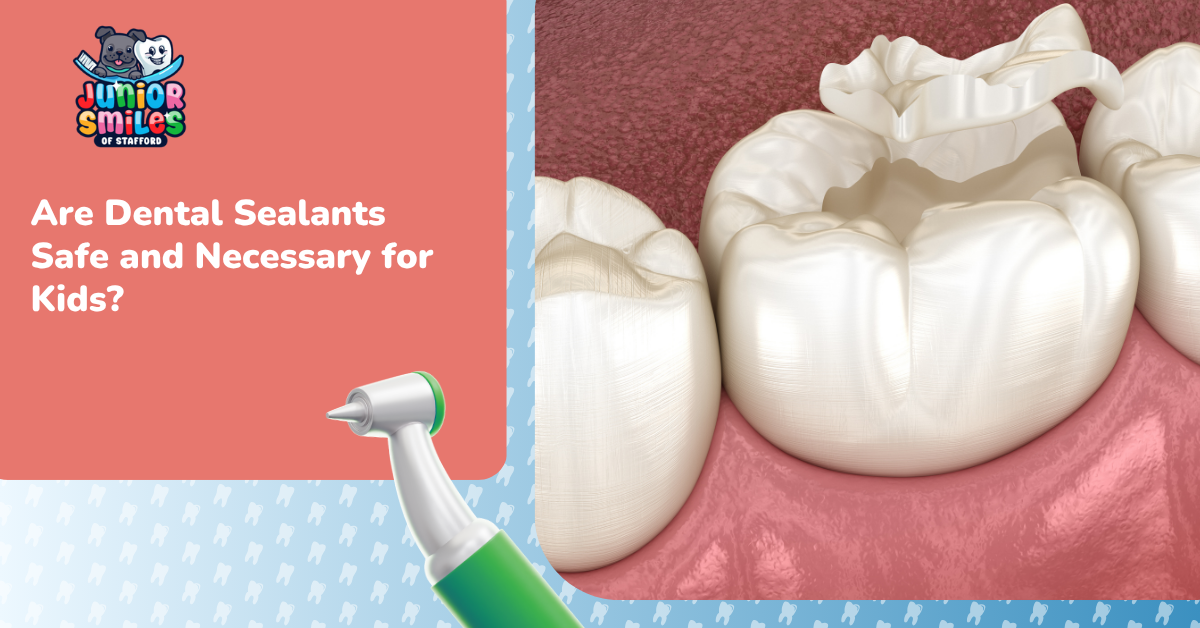
Dental sealants are one of the most effective tools in the preventive arsenal, yet they aren’t automatically applied to every tooth. Clinical guidelines from the ADA and AAPD suggest that sealants should be recommended based on “fissure morphology” the specific depth and shape of the grooves on the chewing surfaces of the molars.
The Question to Ask:
“Based on the depth of the pits and fissures in my child’s molars, are they a candidate for sealants today, or should we monitor the eruption stage first?”
The Clinical Layer
This question moves past “should we get sealants?” and into “why this tooth now?” Pediatric dentists look at the eruption stage of the permanent molars. If a tooth is only partially erupted, the “fissure morphology” might make it difficult to keep dry enough for a successful sealant bond.
Recent data shows that sealants reduce the risk of decay in the permanent molars by nearly 80%. Furthermore, modern protocols allow for the “Sealing of Non-Cavitated Carious Lesions” essentially placing a sealant over a “watch” area to stop an incipient lesion (a beginning-stage cavity) from progressing. Providing your child with this protection early can save them from a multi-surface composite filling later.
Read more: Are Dental Sealants Safe for Kids? A Stafford Pediatric Dentist Answers Your Toughest Questions
Ask About the Fluoride Protocol
Fluoride is often a topic of parent-to-parent discussion, but clinical decisions should be based on data rather than trends. The ADA Evidence-Based Clinical Recommendations suggest that topical fluoride varnish (specifically 5% NaF varnish) leads to a significant reduction in caries for high-risk children.
The Question to Ask:
“What individualized fluoride protocol are you recommending for my child’s specific risk level and our local water fluoridation?”
Understanding the Numbers
This isn’t a one-size-fits-all recommendation. Your pediatric dentist should consider your child’s total fluoride exposure, including the “parts per million” (ppm) in their toothpaste.
- Standard Pediatric Paste: Typically 1,000–1,100 ppm.
- Prescription-Strength Paste (e.g., SF 5000): Contains 5,000 ppm fluoride, often recommended for children in the “High Risk” CRA category.
If you live in an area of Stafford or Quantico with specific water filtration systems, your child’s professional application frequency might need adjustment. A transparent, evidence-based conversation with your dentist ensures your child gets exactly what they need no more, no less.
Ask What ‘Watch and Wait’ Means for a Specific Finding
The Monitoring Plan
A “Watch” is usually a Code 1 or Code 2 lesion, a change in the enamel that hasn’t yet broken the surface to become a cavity. Instead of filling it, the goal is remineralization.
Your dentist is looking for three clinical signs that a “watch” tooth has successfully arrested (stopped progressing):
- Texture: A change from soft/chalky to hard.
- Color: A shift from bright white (active) to a darker brown/black (arrested/scarred).
- Location: Whether it remains confined to the enamel layer on a follow-up X-ray.
Ask for a concrete monitoring plan. If the area doesn’t show signs of remineralization by the next visit, your dentist might suggest Silver Diamine Fluoride (SDF) , a non-invasive liquid that can stop the decay in its tracks without the need for a drill.
Ask What Habits at Home Would Make the Biggest Difference
Daily prevention connects the clinical visit to your home routine. However, instead of asking “is their brushing okay?”, ask for the one or two high-impact behavioral changes specific to your child’s mouth.
The Question to Ask:
“Beyond the basics, what is the one habit change whether it’s snacking frequency or flossing technique that would have the highest clinical impact for my child specifically?”
The “Stephan Curve” and Manual Dexterity
Clinical research emphasizes the Stephan Curve: the frequency of snacking is often more damaging than the amount of sugar consumed. Every time your child eats, the pH in their mouth drops into an acidic state for 20 minutes. If they snack frequently, their teeth are under constant “acid attack,” preventing the CRA score from improving.
Additionally, consider your child’s developmental milestones. A common benchmark for parents is the “tie your shoes” rule. Typically, until a child has the manual dexterity to tie their own shoes (usually age 7-9), they do not have the fine motor skills to floss effectively without parental help. Ask your hygienist to assess your child’s technique to see if they are ready for autonomy.
Preparing for Your Next Visit: A Parent’s Checklist
To make your next appointment in Stafford as productive as possible, we suggest bringing this list of “Clinical Conversation” questions. The more specific your questions, the more personalized the prevention plan you will leave with.
Clinical Vocabulary Cheat Sheet
- Caries Risk Assessment (CRA): The formal score of how likely your child is to get a cavity.
- Fissure Morphology: The shape and depth of the grooves on the teeth.
- Incipient Lesion: A “pre-cavity” area of demineralization.
- Remineralization: The process of the tooth absorbing minerals to repair early enamel damage.

You aren’t just taking your child to the dentist for a cleaning; you are building a strategy for their future health. By engaging with the “clinical layer” of the visit, you ensure that your child doesn’t just have a good appointment today, but a healthy smile for a lifetime.