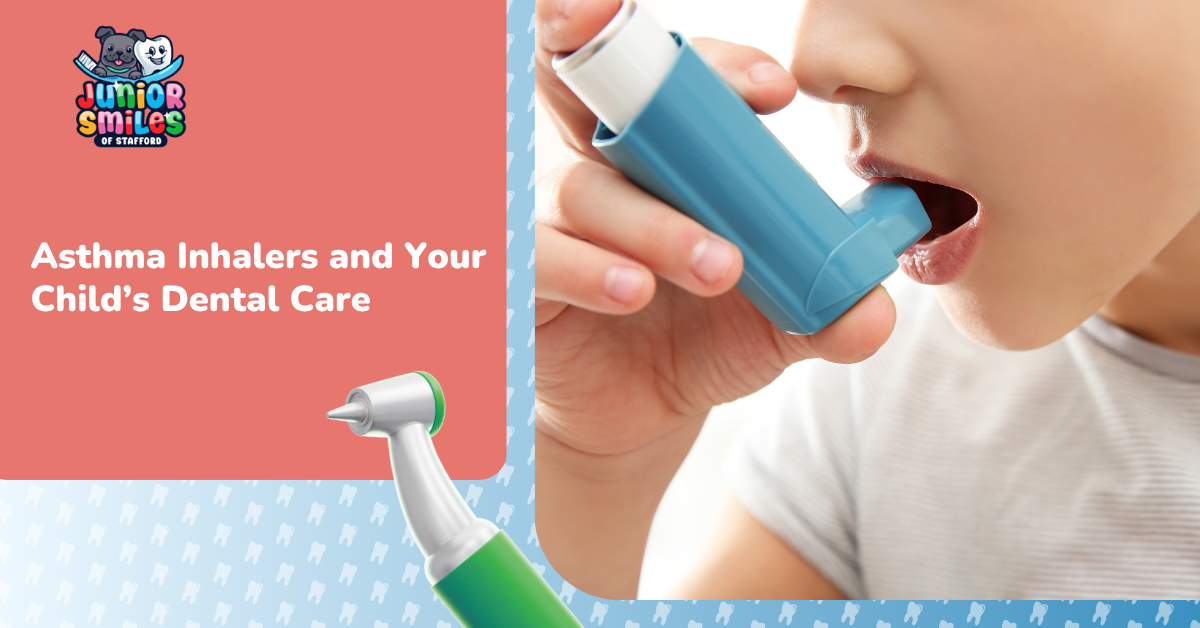
If your child uses an asthma inhaler, tell the dental team which medicine they take and how they use it. That information belongs in the dental history even when asthma seems well controlled and the visit is only for a cleaning.
Protecting your child’s mouth should fit around their prescribed asthma treatment. Do not stop or reduce an inhaler because of a dental concern. Ask the prescribing clinician and dentist to help you coordinate the routine.
The useful questions are specific: Does this medicine contain a corticosteroid? What mouth care is recommended afterward? Has your child developed dryness, soreness, or a change in eating? Here is how to prepare for that conversation.

Start with the medicine name rather than the inhaler color
Bring an up-to-date list of medicines, or the labeled devices themselves, to the appointment. Include inhalers used every day and those used according to the asthma action plan. If another caregiver manages some doses, check the details with them.
Avoid relying on descriptions such as “the blue one” or “the one for nighttime.” Write down the name, strength, and prescribed directions. Include any recent changes and the contact information for the clinician managing your child’s asthma.
You can keep a short note on your phone so you do not have to reconstruct the history in the waiting room. Update it when the prescription changes rather than assuming the dental record will update automatically.
At a dental examination, this information helps make the discussion about your child rather than about inhalers in general.
Ask about mouth care after a steroid inhaler
Some inhalers contain corticosteroids. These medicines can increase the risk of oral thrush, a fungal infection in the mouth. The American Academy of Pediatrics explains that rinsing the mouth or brushing after a corticosteroid inhaler may help reduce that risk.
Follow the instructions for the prescribed product. For a child who can rinse and spit reliably, ask whether rinsing with water and spitting it out should follow each dose. For a younger child who cannot do that, ask the prescribing team to demonstrate an age-appropriate approach.
If the inhaler is used with a spacer or mask, have the clinician or pharmacist check the technique. A spacer must be appropriate for the device; do not add one to a different type of inhaler without instruction. Cambridge University Hospitals provides guidance on metered-dose inhalers and spacers, including mouth rinsing after steroid medication.
The aim is a routine the adults can repeat correctly. Ask for a demonstration if the written directions are difficult to follow.
Describe dryness or soreness without guessing the cause
The American Dental Association explains that medicines can affect the mouth. Dry mouth can increase the risk of decay, and inhaled medicines can be associated with thrush. That does not mean every child using an inhaler will develop either problem.
Tell the dentist about a persistently dry or sticky mouth, mouth soreness, white patches, or discomfort with eating. Note when the change began and whether it followed a new medicine or dose. Do not assume a white patch is thrush or try to scrape it away to prove the diagnosis.
Likewise, a cavity does not establish that an inhaler caused it. The dentist needs to consider the child’s examination, history, home care, and other risk factors. Ask what can be changed in the oral-care routine while the prescribed asthma care continues.
A useful note might say: “The mouth has felt dry most mornings for two weeks. This is the medicine list, and this is when the last prescription changed.” That gives the team more to work with than “the inhaler is ruining the teeth.”
Tell the office about changes before the appointment
If your child has a recent flare-up, ongoing wheezing, or a change in their usual breathing, contact the dental office before the visit. Explain the symptoms and any advice already received from the asthma clinician. The team can advise whether further coordination is needed.
Bring the prescribed reliever medication and any spacer your child uses, together with their action plan. Make sure the accompanying adult knows where they are and how the plan says to use them.
AAPD’s guidance for patients with special health care needs emphasizes medical history, individualized planning, and coordination with other healthcare providers. If sedation is being considered, make sure the team assessing it has the current asthma history rather than information from an earlier visit.
Active breathing difficulty needs care according to the asthma action plan and medical urgency. Severe trouble breathing is an emergency; do not wait for a dental appointment to address it.
Make the home routine easy to hand over
If school staff, a grandparent, or another household helps with inhalers, share the prescribed after-dose mouth-care instructions with them. A routine is easier to maintain when everyone knows which step belongs after which medicine.
Keep dental care in that plan too. Ask the dentist to demonstrate brushing and cleaning between teeth for your child’s age and abilities. If dryness or soreness makes brushing difficult, explain where the problem occurs rather than quietly dropping that part of the routine.
You can ask: “What should we do after this inhaler, what should we do at bedtime, and what change should make us call?” Write down the answers from the appropriate clinician so they are easy to refer to later.
For families in Stafford, request a visit with Junior Smiles and mention the asthma history when booking. Bring the medicine list and the questions you want to work through.

Frequently asked questions
Should we stop an inhaler if my child gets a cavity?
No. Do not stop or alter prescribed asthma medicine on your own. Ask the dentist and prescribing clinician to assess the concern and help adjust mouth care while maintaining asthma treatment.
Does every asthma inhaler cause thrush?
No. Oral thrush is a possible side effect associated particularly with inhaled corticosteroids, not an inevitable outcome. Confirm what your child’s medicine contains and follow its mouth-care instructions.
What if my child cannot rinse and spit?
Ask the prescribing clinician or pharmacist to show you an approach suited to the child’s age and device. Do not assume adult rinsing instructions are appropriate for a toddler.
What should I bring to the dental appointment?
Bring an updated medicine list, the asthma action plan, and the prescribed reliever inhaler and spacer if used. Tell the team about recent flare-ups, prescription changes, and any mouth symptoms.