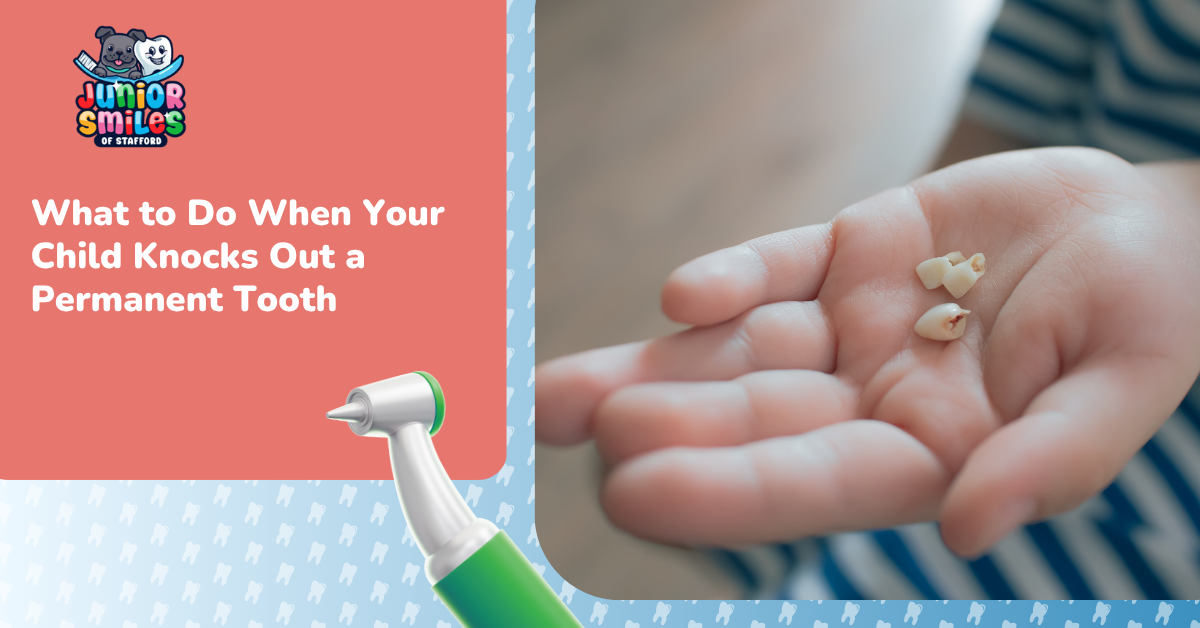
If your child has knocked out a permanent tooth, seek urgent dental care now. Handle the tooth by its crown, keep it from drying out, and call a dentist immediately. A baby tooth must not be put back into its socket.
At Junior Smiles of Stafford, the first things we want parents to remember are moisture and speed. Put the tooth in milk if you cannot safely replace it, call for urgent instructions, and bring your child for care. Even when a tooth looks intact, it needs professional assessment.

First check your child for serious injuries
Before focusing on the tooth, check that your child is breathing normally and responding to you. Call emergency services for breathing difficulty, unconsciousness, severe uncontrolled bleeding, or signs of a serious head or neck injury. Medical stabilization takes priority.
If another adult is present, one person can help the child while the other finds the tooth and calls for care. Describe the injury clearly: when it happened, whether the tooth is completely out, and whether your child has other symptoms.
Is it a baby tooth or a permanent tooth?
Children can have both types of teeth at the same time. Age alone is not a reliable way to decide which tooth was lost. If you are unsure, call a dental professional immediately, keep the tooth moist, and do not force it into the socket.
Do not replant a baby tooth. Doing so can harm the developing permanent tooth. A knocked-out baby tooth still warrants dental assessment to check the injury, nearby teeth, and any missing fragments. It is not something to dismiss because the tooth would eventually have fallen out.
A permanent tooth needs especially prompt attention because replantation may be possible. The goal is to protect the root surface and get professional care quickly.
How do I handle a knocked-out permanent tooth?
The AAPD’s emergency advice for parents recommends holding the tooth by the crown and seeking immediate dental care. The crown is the part that normally shows above the gum. Avoid touching or scraping the root.
- Pick up the tooth by the crown.
- If dirty, rinse it gently with milk, saline, or the child’s saliva. Do not scrub it or use soap, alcohol, or disinfectant.
- If you are certain it is a permanent tooth and your child is alert and cooperative, gently try to place it back in its socket. Do not force it.
- If it goes back easily, have your child gently bite on clean gauze or a cloth to help hold it in position while you obtain care.
- If you cannot safely replace it, put it in milk or a commercial tooth-preservation solution and leave for urgent dental care.
Do not try replantation in an unconscious or uncooperative child, and do not keep a loose tooth in a young child’s mouth for storage. There is a risk of swallowing or inhaling it. Use a container instead.
Why put the tooth in milk?
A dry tooth has a poorer outlook. Milk is a practical storage option that helps protect the root surface while you travel. A tooth-preservation solution, often sold for dental emergency kits, is another option.
Do not spend time looking for a particular brand or fat percentage of milk. Use what is readily available and call for guidance if you do not have milk or a preservation solution. Do not wrap the tooth in dry tissue, leave it on a counter, or let the search for supplies delay care.
Storage is a temporary measure. It does not stop the clock or make it safe to wait until tomorrow. Tell the dentist how long the tooth was out of the mouth and how long it was dry, as accurately as you can.
Can a tooth still be treated if it has been out a while?
Yes, it still needs urgent assessment. Do not decide at home that the tooth is beyond help or throw it away. Bring it with you even if it was found late, has been stored poorly, or looks damaged.
The outcome depends on several factors, including the time outside the mouth, storage conditions, root development, and other injuries. Replantation does not guarantee that a tooth will survive long term. The dentist will explain the realistic goals and follow-up needs for your child.
What happens at the emergency appointment?
The dentist will assess the tooth, socket, gums, and surrounding teeth, and may take radiographs. Share the time and cause of injury, the storage method, your child’s medical history, and any treatment already given.
The IADT guidelines endorsed by the AAPD describe care that may include replantation, a flexible splint, and continuing assessment. Decisions about medication, tetanus status, and treatment inside the tooth depend on the injury and the child.
Ask for written instructions about eating, cleaning, activity, and follow-up. A tooth can appear comfortable while healing problems develop, so scheduled reviews matter even after the initial pain settles.
What if I cannot find the tooth?
Tell the dentist that the tooth is missing and could not be located. What looks like a knocked-out tooth can sometimes be a tooth pushed into the gum, and a missing tooth or fragment may need further investigation.
If your child is coughing persistently or struggling to breathe after the injury, seek emergency medical care. Do not delay that assessment while searching the ground or trying to determine where the tooth went.

Frequently asked questions
Should I put a baby tooth back?
No. Keep it out of the socket and arrange dental assessment. Replanting a baby tooth can damage the developing permanent tooth.
Should I wait until the bleeding stops before calling?
No. Call promptly while helping your child. Severe uncontrolled bleeding or other serious injuries require emergency medical care.
Is milk enough to save the tooth?
Milk helps keep the tooth moist during transport, but it does not guarantee survival. Immediate dental care and follow-up are still necessary.
Get urgent dental help
Contact Junior Smiles of Stafford immediately after a dental injury. If the office cannot provide timely care, seek an available emergency dental provider. Do not wait for a routine appointment or an online form response.
After the immediate injury is addressed, ask about a well-fitting sports mouthguard when your child is cleared to return to activities. Bring any current mouthguard to a future visit so its fit can be considered as your child’s teeth change.