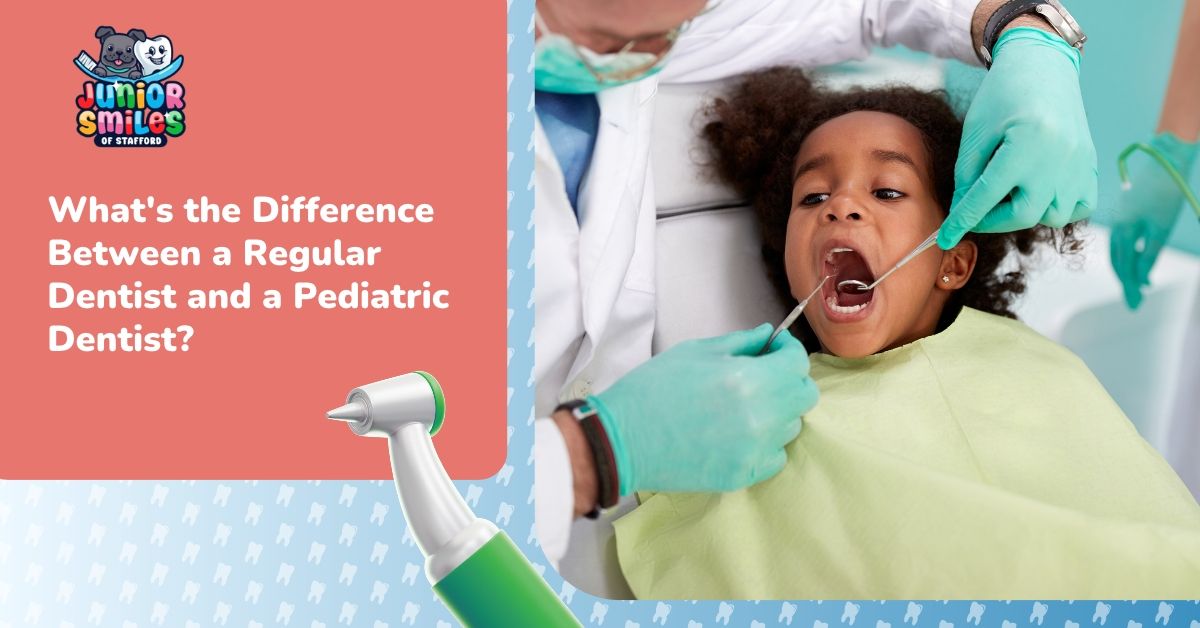
Both general dentists and pediatric dentists can care for children’s teeth. The main difference is that pediatric dentists complete additional specialty training focused on children and their development. For families choosing dental care in Stafford VA, the useful question is which provider can meet your child’s needs and make regular care manageable.
At Junior Smiles of Stafford, our work centers on children’s dental care. Here is how to compare your options without assuming that every child needs the same type of practice.

What the training difference means
A general dentist completes dental school and can provide preventive and restorative care to patients of different ages. A pediatric dentist completes further specialty training in children’s oral health, including growth, behavior guidance, and care for children with special healthcare needs.
That training can be useful when the treatment plan depends on a child’s stage of development, ability to cope with an appointment, or medical needs. It does not mean that a general dentist cannot provide good care for a child. The ADA explains that either can be an appropriate choice, depending on the child and the family.
The term “family dentist” generally describes a practice serving different ages. Ask about the individual dentist’s training and experience rather than relying only on the wording in the practice name.
What child-focused care can look like
In a Junior Smiles video, Dr. Pope describes what happens when a child will not open their mouth. For younger children, he discusses a knee-to-knee position involving the parent and provider. For older children, he describes tell-show-do: explaining a step, showing it, and then carrying it out when the child is ready.
He also describes slowing down, asking what feels worrying, and sometimes arranging another visit. The point is to understand the child rather than assume that reluctance is deliberate misbehavior.
Some children need more than one visit to become comfortable with care. General dentists may use child-friendly techniques too. Ask any office how it would respond if your child became overwhelmed.
Compare the care your child actually needs
For a child who is comfortable at a trusted family practice, continuity may be a good reason to stay. If the child has complex dental needs, significant anxiety, or a condition requiring additional support, ask whether pediatric expertise would be helpful.
Consider practical details as well. Can the practice explain its recommendations clearly? Will it coordinate with other providers when needed? Can you follow the proposed appointment schedule? Those answers matter more than a colorful waiting room alone.
You can explore the treatments available at Junior Smiles and discuss which are relevant to your child. A list of services should start a conversation, not make you feel that your child needs every service listed.
Questions to ask before booking
- What ages and needs does the dentist regularly treat?
- How do you introduce an unfamiliar procedure to a child?
- What happens if my child needs a break or cannot complete the visit?
- How will you explain treatment options and costs to me?
- When would you recommend referral to another specialist?
Tell the office about previous dental experiences, communication preferences, and anything that helps your child feel comfortable. For more support with that conversation, read how we approach anxious children’s care. Anxiety alone does not determine a sedation plan.
Does changing dentists mean starting over
If you decide to change practices, ask how to transfer the relevant records. Share recent treatment plans and radiographs through the offices’ preferred secure process. Bring a current medicine list and explain any symptoms or unfinished treatment.
Dr. Pope’s introductory video welcomes families’ dental questions, including requests for another opinion. You can ask for an explanation without committing to treatment immediately. If care is urgent, ask how much time is available to make the decision safely.
What happens at an early dental visit
An early visit creates an opportunity to discuss feeding, cleaning, tooth development, and cavity risk before a problem becomes painful. The ADA recommends a first visit after the first tooth appears and no later than the first birthday. This applies whether the chosen provider is a general dentist who treats infants or a pediatric dentist.
Ask what the appointment is likely to include for your child’s age. A visit for a baby can look different from one for a school-age child. Share what products you use at home and any concerns about brushing or eating. You should leave understanding the next preventive steps and when to return.
If your child is older and has not yet been seen, book now rather than waiting for a more convenient milestone. In Dr. Pope’s first-visit video, his message to parents of a four-year-old is to begin the dental journey without dwelling on the missed starting point.
When additional expertise may be helpful
The AAPD describes pediatric residency training as including child development, diagnosis, trauma care, and clinical management for children with a range of needs. This is relevant when a family needs more than a routine appointment can comfortably provide.
For example, a child may need several procedures but become distressed during even a brief examination. Another may have a medical condition that affects planning. Ask how the dentist would coordinate the dental and comfort needs, and whether referral would improve access to suitable care.
Specialty training does not remove the need for individual assessment. The AAPD’s behavior-guidance recommendations emphasize communication, informed consent, and a plan matched to the child. A diagnosis or behavior label alone should not determine the entire appointment approach.

Common questions when comparing dentists
Is it worth going to a pediatric dentist
It can be, particularly when the specialty focus matches your child’s needs. Compare the dentist’s experience, explanations, approach to comfort, and ability to provide or coordinate the proposed care. A child doing well with a general dentist does not automatically need to switch simply because another office uses the word pediatric.
Does a pediatric dentist also straighten teeth
Pediatric dentists monitor dental development and may identify spacing or bite concerns. Orthodontics is a separate specialty focused on tooth alignment and bite correction. Ask which services the practice provides and when it recommends an orthodontic assessment; do not assume all early dental-development care is the same as braces treatment.
Should I choose solely by which office accepts insurance
Coverage is a practical consideration, but also confirm that the office can meet your child’s needs. Ask about network status, the expected cost of the visit, and referral requirements before booking. Clear financial information helps you plan consistent care with a suitable provider.
Meet the team and discuss the fit
Learn more about Dr. Zeina Estephan and Dr. Angelo Pope Jr. before booking. Bring your child’s needs and your own questions into the conversation. The goal is a dental home where the care is appropriate, the explanations make sense, and your family can keep returning consistently.